Why does AC freeze up in Lee's Summit, MO homes right when you need cooling the most? It almost always comes down to one of a handful of fixable problems: blocked airflow, low refrigerant, a dirty coil, a failing blower, or running the system in weather it wasn't built for. Here's how to spot it, confirm it, and fix it without making the damage worse.
What Causes an Air Conditioner to Freeze Up?
An air conditioner freezes when the evaporator coil gets too cold for too long. That happens for two basic reasons: restricted airflow across the coil, or low refrigerant pressure inside it.
Your system needs a steady stream of warm indoor air moving across that coil. Block that airflow, or let refrigerant drop below where it's supposed to sit, and the coil's surface temperature falls out of range.
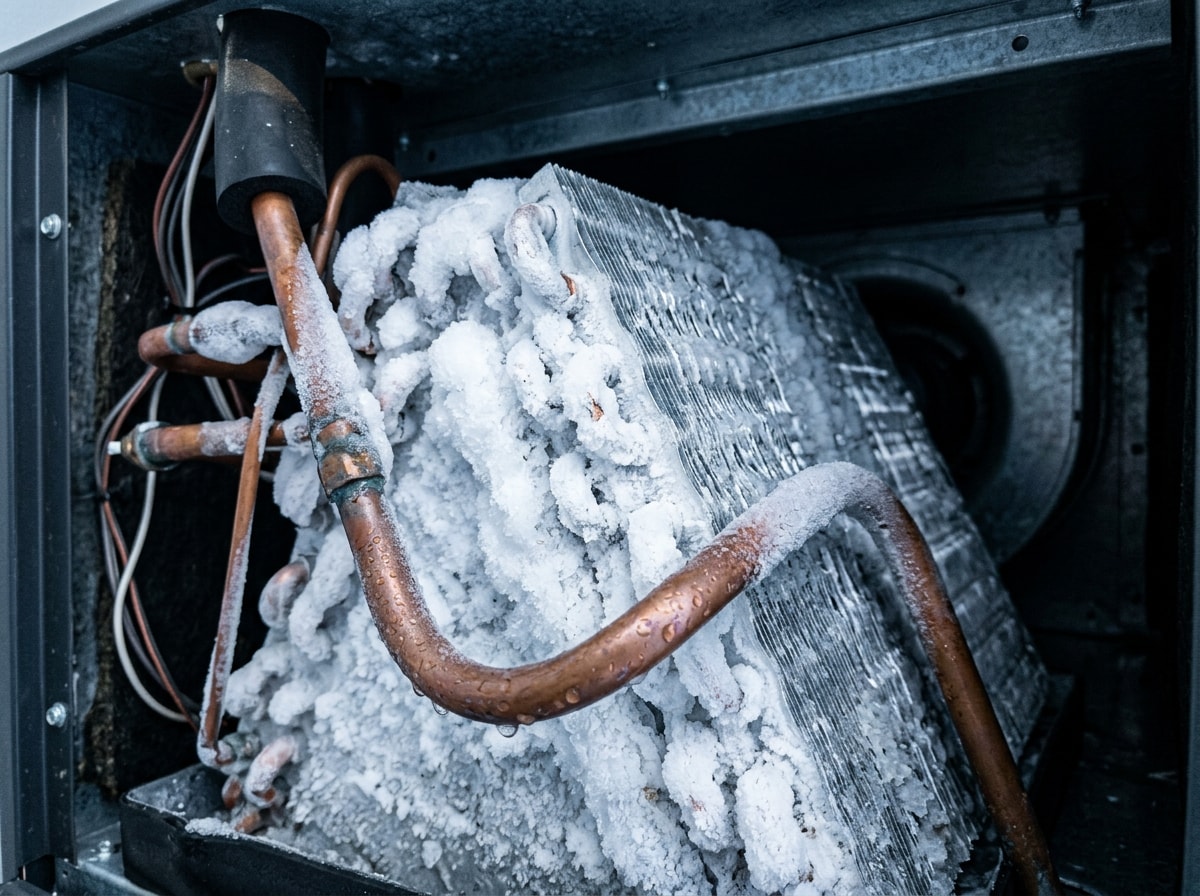
Once it dips below freezing, condensation that would normally drip into the drain pan turns to ice instead. That ice builds on itself, choking off airflow further the longer the unit runs.
Most home cooling systems are engineered around a tight balance between airflow volume and refrigerant pressure. When either side of that equation is off, a frozen coil is usually the visible result.
Signs Your AC Is Freezing Up
Watch for these before you ever pull the access panel:
- Warm air coming from the vents instead of cold
- The system running nonstop without actually cooling the house
- Weak or lukewarm airflow at the registers
- Indoor humidity that feels stickier than usual
- Water pooling near the indoor unit
- Visible ice or frost on the coil or refrigerant lines when you open the panel
Any one of these on its own is worth investigating. Seeing actual ice on the coil is the clearest confirmation, but a lack of visible ice doesn't rule out a developing freeze; the coil can be icing internally before frost ever shows.
Common Causes of an AC Freezing Up
Most freeze-ups trace back to one of five recurring problems. Here's a quick reference before the detailed breakdown:
| Cause | Can You Check It Yourself? | Needs a Pro? |
|---|---|---|
| Dirty or clogged air filter | Yes, check and replace | No |
| Blocked vents or closed doors | Yes, open and clear them | No |
| Low refrigerant / leak | You can notice symptoms; can't fix | Yes, EPA-certified technician |
| Dirty evaporator coil | Hard to inspect without removing panels | Usually |
| Failing blower motor/fan | You can listen for weak airflow | Yes |
| Thermostat set wrong for cool weather | Yes, check settings | Only if it keeps happening |
Restricted or Blocked Airflow
Restricted airflow is the single most common reason coils freeze. When too little warm air moves across the evaporator coil, it gets colder than it should, and moisture that normally condenses and drains away freezes onto the surface instead.
A handful of everyday issues cause this:
- A dirty air filter clogged with dust and pet hair
- Closed interior doors that cut off return airflow
- Furniture blocking return vents
- Dust buildup directly on the coil
Checking your filter and making sure vents aren't blocked are the two easiest things to rule out before calling anyone.
A clogged filter doesn't just risk a freeze. It also forces the system to work harder across the board, which drives up energy use. ENERGY STAR notes that a dirty filter slows airflow and makes your heating and cooling system work harder, wasting energy and risking early equipment failure. If you're already dealing with a frozen unit, it's worth having a professional AC repair technician inspect the full airflow path rather than just swapping the filter and hoping.
Low Refrigerant
Low refrigerant sounds backwards as a cause of freezing, but the logic holds. When refrigerant drops, pressure drops with it, letting the remaining refrigerant expand and cool the coil far below its normal operating range.
Low levels almost always point to a leak somewhere in the lines. Refrigerant doesn't get consumed like fuel, so if it's low, it's escaping somewhere. A faint hissing sound or unusually warm air from the vents can be a side effect.
This is one case where DIY isn't an option. Refrigerant handling requires EPA certification, and simply topping off a leaking system only masks the problem while more refrigerant escapes. Refrigerant rules have also been tightening: the EPA's HFC phasedown program is changing which refrigerants are available for recharge, which is one more reason this job belongs to a licensed technician, not a hardware-store can. If you suspect a leak, a refrigerant recharge performed correctly means finding and sealing the leak first, not just adding more refrigerant.
Dirty Evaporator Coil
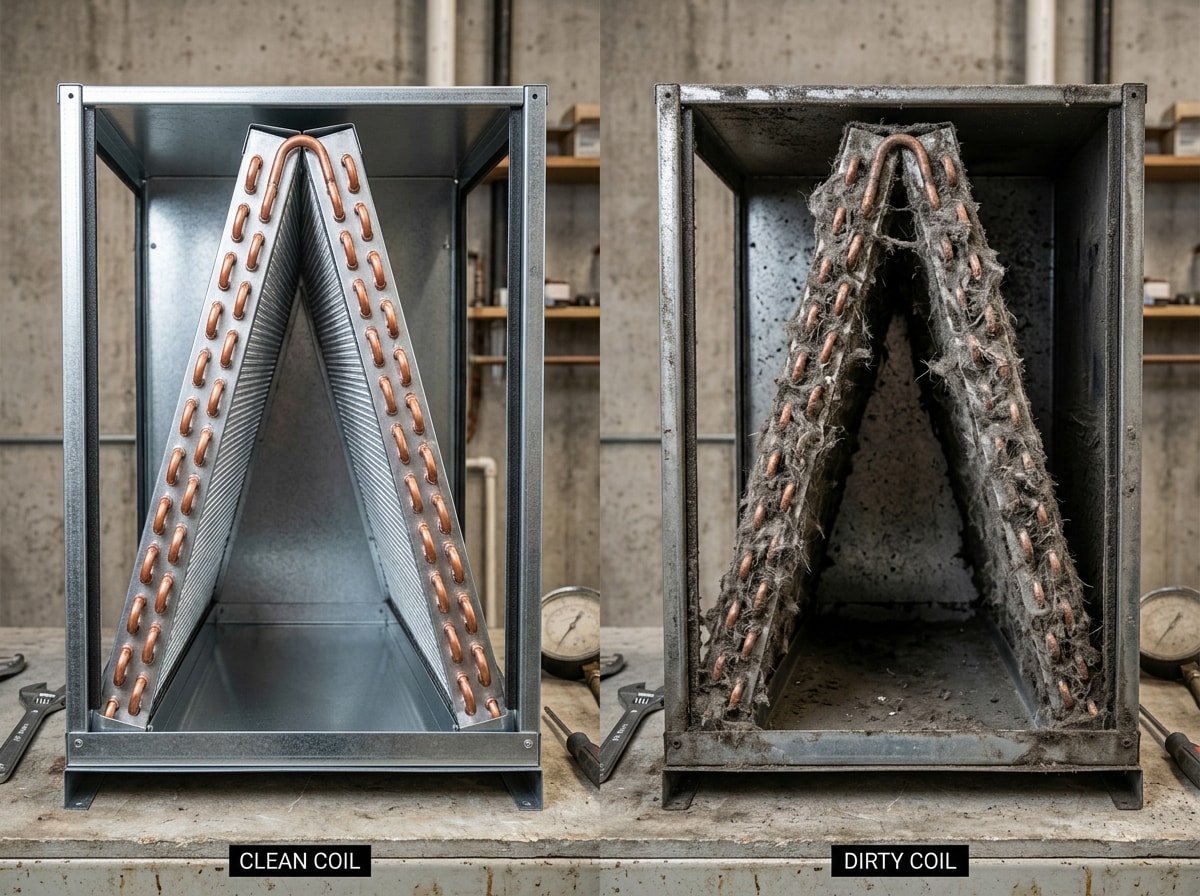
A dirty coil is easy to overlook because it builds up gradually. Dust and grime settle on the surface over months or years, and that layer insulates the coil, blocking the heat transfer it depends on.
The coil ends up running colder than it should just to compensate, which sets the stage for a freeze. Dirt doesn't stop there either; it can migrate into the condensate drain line and clog it, forcing the system to run longer and harder to reach the same temperature.
Regular evaporator coil cleaning as part of routine AC maintenance is one of the simplest ways to keep this cause from ever becoming a problem.
Malfunctioning Blower Fan
A blower fan running slower than it should puts extra strain on the system, since it can't move enough air to keep up with the cooling happening at the coil. If the motor fails outright, airflow drops to nearly zero, pressure shifts, and the refrigerant over-expands and gets abnormally cold.
Either way, a failing blower motor is mechanical, not something a filter change will fix.
Thermostat Issues & Running the AC in Cool Weather
Running your AC when outdoor temperatures dip below roughly 60°F, or dealing with a miscalibrated thermostat, can push the system to run longer than it needs to, chilling the coil past its safe range. Setting the thermostat fan to AUTO rather than ON is a simple first check.
This cause matters more locally than it might seem. The National Weather Service's Kansas City-area climate records show early October normal highs in the low-to-mid 70s with normal lows in the high 40s to low 50s, a swing of more than 20 degrees in a single day. Those climate normals confirm this kind of day-to-night spread is a routine pattern here, not an unusual fluke. Spring shows the same pattern in reverse, with mild afternoons and much colder mornings.
Homeowners who leave the AC running through those cool nights, rather than letting the thermostat cycle naturally, are unknowingly recreating the exact conditions that cause freezing in mild weather. If your system keeps icing up during these shoulder-season weeks, it's worth having a technician check your thermostat calibration, or consider upgrading to a smart thermostat that adjusts more precisely to outdoor swings.
What to Do When Your AC Unit Freezes Up
Once you've confirmed ice on the coil, the order of operations matters more than the diagnosis itself.
Step 1: Thaw it completely. Turn the system off and let the ice melt on its own. Depending on how much built up, this can take anywhere from a couple of hours to a full 24 hours. Don't chip or scrape ice off the coil; forcing it off risks damaging the fins or refrigerant lines underneath.
Step 2: Find the cause and fix it. Once the unit is fully thawed and dry, check the easy stuff first:
- The air filter
- Whether vents and registers are blocked
- Whether the thermostat is set to AUTO and wasn't running during unusually cool weather
Other causes aren't DIY territory. Refrigerant leaks, blower motor failure, and a worn compressor all require diagnostic tools and certification to address safely.
If you've ruled out the filter and thermostat settings and the unit still freezes, that's the point to schedule AC repair with a licensed technician rather than keep testing fixes on your own. On service calls across Lee's Summit, we see this pattern most often in homes with closed-off bedrooms or furniture pushed up against return vents, so that's usually the first thing worth ruling out before assuming it's refrigerant.
If your AC has frozen more than once this season, don't wait for a full breakdown. Get a free estimate and have a technician trace the real cause before it turns into a compressor repair.
FAQ
Should I turn off my AC if it's frozen?
Yes. Turn the unit off right away and let the ice melt completely before running it again. Don't try to break up the ice to speed things along; forcing it off can damage the coil, fins, or refrigerant lines underneath.
How long do I leave my AC off to defrost?
Thawing can take anywhere from a few hours to as long as 24 hours in severe cases, depending on how much ice built up. Once the coil is fully dry, restart the system with the fan set to auto and give it an hour or so to confirm normal operation.
Can an overworked air conditioner freeze?
Yes. Running a system constantly during a heat wave, or asking it to handle more cooling demand than it's sized for, can lower internal pressure enough to cause the coil to freeze, even without a separate mechanical problem.
Can a dirty air filter really cause my AC to freeze?
Yes, on its own. A heavily clogged filter restricts enough airflow across the coil that the coil's temperature drops below freezing even if every other component is working fine. It's the single most common cause.
Why does my AC only freeze up at night?
Cooler overnight temperatures lower the cooling load, but if the thermostat keeps calling for cooling anyway, the coil can run colder than it needs to. This is especially common during Lee's Summit's spring and fall shoulder seasons, when daytime highs and nighttime lows can differ by 20 degrees or more.
Can I use a hair dryer or a fan to thaw my AC faster?
A fan blowing room-temperature air across the coil (with the system's cooling mode off) can help speed up thawing safely. Skip the hair dryer; concentrated heat on the coil fins can warp them and create a bigger repair than the freeze itself.
---
This guide was reviewed by the licensed HVAC technicians at Jackson County Comfort, who service residential heating and cooling systems throughout Lee's Summit and the greater Kansas City metro. For more troubleshooting steps on cooling problems in the area, see our guide on heating and air conditioning repair near you in Independence, MO. Questions about a frozen unit that keeps coming back? Contact us for a free estimate.